
How people play
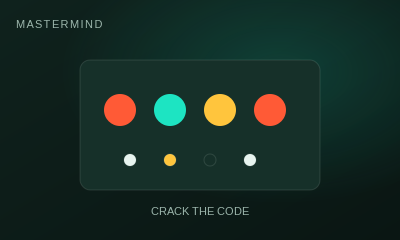
One player sets a four-colour secret, the other has 10 guesses. Black pegs mark an exact match, white pegs mark a colour in the wrong place, and a colour is never counted twice. Friends open a room and swap roles; vs Computer lets you break a random code, or set one and watch the hard bot work through the remaining possibilities.
Common challenges
- Ignoring earlier pegsA later guess that could not produce the pegs you already have is wasted.
- Forgetting duplicatesTwo reds in a guess only score as many pegs as there are reds in the secret.
- Changing a known blackOnce a colour is locked in the right place, moving it costs you a guess.
What strong play proves
Winning Mastermind shows you can hold several constraints at once and still act under a short clock of remaining rows.
What it improves
- Forward planningYou rehearse “if I do this, they do that” before you commit.
- Sustained focusShort matches still punish zoning out for a single beat.
- Pattern recognitionWins come from spotting shapes, threats, and repeats early.
- ComposureMistakes happen — recovering cleanly is the real skill.
Best for
A change of pace after a reaction or arcade duel.